

The 2008 Business Case and Feasibility Study investigated a major redevelopment of the 40-year-old Canberra Theatre Centre to provide a 2,000 seat lyric theatre capable of hosting major international and national touring shows.
The revised facilities are to include the three level lyric theatre and associated front of house and backstage support, stagehouse and backstage, new 300 seat studio theatre, improved rehearsal room, new administration for 50 staff, upgraded foyer and patrons amenities and improved aspect and relationship to Canberra’s Civic Square. A variety of siting and planning options were investigated to identify a preferred development model.
In 2012 and 2015 we undertook further concept design studies of the lyric theatre to assist the Cultural Facilities Corporation to advance the project.


Williams Ross Architects led a business case and feasibility study into the redevelopment of the thirty-year-old performing arts centre in a sensitive parkland setting.
Market and needs analysis by Positive Solutions and Artefact Consulting confirmed that redevelopment would ideally include a 600 seat proscenium theatre, 200 seat multi-purpose studio theatre, rehearsal room, improved external soundshell stage and 300 person function rooms, together with associated support facilities.
The study included review of existing conditions, theatrical and services scope investigations, flood mapping and car parking analysis, which identified the need for 200 additional car parks. Positive Solutions and Artefact Consulting prepared a five-year business case and operating budgets.
After the Business Case was considered by Council we conducted a public consultation process to engage community feedback, reporting to Council in June 2015.


Williams Ross Architects led a consortium of theatrical and engineering consultants in this major consultancy for the State Government and Victorian Association of Performing Arts Centres in which we developed design and technical benchmarks for proscenium, ‘other format’ theatres and concert venues. The performing arts industry was consulted in developing the benchmarks.
Facility audits of 30 performing arts centre venues throughout Victoria were conducted to report on their condition and recommend upgrades to meet the recommended benchmark, including a detailed audit report and cost estimate.
The three-volume report was adopted as part of the assessment criteria for performance venue funding applications to State Government. Over 2,000 copies of the Benchmarks have been distributed throughout Australia and internationally, becoming the recognised reference for design and technical fitout of performing arts facilities.
Director Virginia Ross was lead consultant, author and editor of the First Edition and co-author with Marshall Day Entertech of the Third (current) Edition.

Planning for additional classrooms and specialist facilities for the 1,300 student school reinforcing existing quadrangles while forming year level precincts. Preservation of the historic C1900 gothic Convent, and complex staging of works were key issues.
Other projects we have delivered for the College include new physical education centre, new performing arts and music school, Year 7 classroom building, food technology renovation, administration rework, toilet refurbishments, and maintenance facility.


Gore Hill Park, bounded by the heritage classified Gore Hill Cemetery and Royal North Shore Hospital, is a prominent and challenging site in St Leonards North Sydney.
The proposed development is to include six indoor sports courts, 150 seat function room, full AFL synthetic grass oval re-surfacing, covered spectator seating for 250 people, oval change rooms (four teams), match day facilities and 250 plus on site car parking spaces.
Three design options explored potential solutions to satisfy the siting requirements and the user group needs and the concept study involved consideration of site analysis, environmental sustainability, transport and traffic, arboriculture, site infrastructure, and building and site layout. The final study was endorsed by Council in late 2014 and is proceeding to Schematic Design.


This was an extensive review of existing facilities, buildings, location, access, future capacity and context of early years services to inform new council policies and planning. Horsham North was identified as the first priority for provision of a new integrated early years service in the near future.
A short-term master plan was prepared for kindergarten, childcare and maternal and child health facilities, administration and multi-purpose community spaces. Outdoor recreation spaces were important given the centre’s location on a recreation park. Council has presented the reports and drawings to the Horsham community for comment.


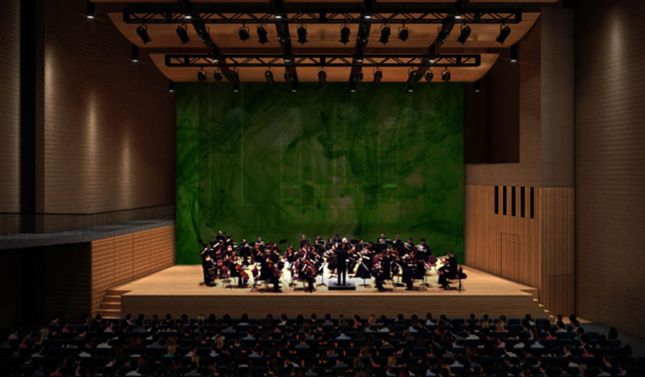
Facility planning and concept design for a major functional upgrade of the Robert Blackwood concert hall, together with a new facility for the adjacent School of Music. The Robert Blackwood Hall is regarded as one of Australia’s finest concert halls, seating 1600 patrons, and used for a wide range of community and university events. Designed by Sir Roy Grounds and featuring a magnificant Leonard French stained glass window, it is considered an important piece of twentieth century Australian architecture.
The Concert Hall needs expanded support facilities from foyer to patron amenities, function rooms, backstage and staff facilities, a general refurbishment, compliance upgrades and updated technical and acoustic facilities.
Proposed School of Music facilities include six large ensemble rooms and recording studios and numerous group and individual practice rooms, all requiring substantial acoustic treatment.
The concept identified opportunities to wrap new facilities around the frontage achieving ideal functional relationships, enhanced disability access to existing levels, and a new transparent facade to the imposing building.


WRA was one of the six panel members for the ARV study and report into Pool Concourse Design, Construction, Management and Maintenance.
The aim of the study was to provide Local Council as aquatic facility providers with the broad knowledge needed to inform their understanding of pool concourse operational issues, performance, risk management, and technical details when considering a new or upgraded surface. The advantages and disadvantages of several commercially available surface options were assessed and site visits undertaken to evaluate those surfaces in operation at several venues in and around Melbourne.
Since the publication of the report in July 2011 the guidelines have become an industry standard and are regularly included with project briefs for new aquatic facilities.

In late 2011 ARV developed an Aquatic and Recreation Facility Brief Template as a guide for local councils considering the development of new or upgraded facilities. As one of three panel members, WRA contributed to both the initial template development workshops and the peer review on completion of the document.
The template sought to address issues associated with the effective documentation by council at the project inception of the key elements to form their project Functional Design Brief. The high level information, which aimed to describe council’s expectations and project parameters, would subsequently be utilised in consultant tender documentation, enabling council to elicit informed and more comprehensive tender responses or detailed return briefs from a principal consultant or project manager.

 Canberra Theatre Centre Business Case
 Whitehorse Centre Redevelopment Business Case
 Oh You Beautiful Stage design benchmarks
 Sacred Heart College Master Plan, Geelong
 Gore Hill Park Feasibility Study, St Leonards
 Horsham Early Year Services Infrastructure Project
 Robert Blackwood Concert Hall
 ARV Pool Concourse Guidelines: Design construction management and maintenance considerations
 ARV Functional Design Brief Template
Canberra Theatre Centre Business Case
Whitehorse Centre Redevelopment Business Case
Oh You Beautiful Stage design benchmarks
Sacred Heart College Master Plan, Geelong
Gore Hill Park Feasibility Study, St Leonards
Horsham Early Year Services Infrastructure Project
Robert Blackwood Concert Hall
ARV Pool Concourse Guidelines: Design construction management and maintenance considerations
ARV Functional Design Brief Template
ARV Functional Design Brief Template
Canberra Theatre Centre Business Case
Whitehorse Centre Redevelopment Business Case
Oh You Beautiful Stage design benchmarks
Sacred Heart College Master Plan, Geelong
Gore Hill Park Feasibility Study, St Leonards
Horsham Early Year Services Infrastructure Project
Robert Blackwood Concert Hall
ARV Pool Concourse Guidelines: Design construction management and maintenance considerations
ARV Functional Design Brief Template